README
Chapter 9: Learning and Adaptation
Learning and adaptation are pivotal for enhancing the capabilities of artificial intelligence agents. These processes enable agents to evolve beyond predefined parameters, allowing them to improve autonomously through experience and environmental interaction. By learning and adapting, agents can effectively manage novel situations and optimize their performance without constant manual intervention. This chapter explores the principles and mechanisms underpinning agent learning and adaptation in detail.
The big picture
Agents learn and adapt by changing their thinking, actions, or knowledge based on new experiences and data. This allows agents to evolve from simply following instructions to becoming smarter over time.
Reinforcement Learning: Agents try actions and receive rewards for positive outcomes and penalties for negative ones, learning optimal behaviors in changing situations. Useful for agents controlling robots or playing games.
Supervised Learning: Agents learn from labeled examples, connecting inputs to desired outputs, enabling tasks like decision-making and pattern recognition. Ideal for agents sorting emails or predicting trends.
Unsupervised Learning: Agents discover hidden connections and patterns in unlabeled data, aiding in insights, organization, and creating a mental map of their environment. Useful for agents exploring data without specific guidance.
Few-Shot/Zero-Shot Learning with LLM-Based Agents: Agents leveraging LLMs can quickly adapt to new tasks with minimal examples or clear instructions, enabling rapid responses to new commands or situations.
Online Learning: Agents continuously update knowledge with new data, essential for real-time reactions and ongoing adaptation in dynamic environments. Critical for agents processing continuous data streams.
Memory-Based Learning: Agents recall past experiences to adjust current actions in similar situations, enhancing context awareness and decision-making. Effective for agents with memory recall capabilities.
Agents adapt by changing strategy, understanding, or goals based on learning. This is vital for agents in unpredictable, changing, or new environments.
Proximal Policy Optimization (PPO) is a reinforcement learning algorithm used to train agents in environments with a continuous range of actions, like controlling a robot's joints or a character in a game. Its main goal is to reliably and stably improve an agent's decision-making strategy, known as its policy.
The core idea behind PPO is to make small, careful updates to the agent's policy. It avoids drastic changes that could cause performance to collapse. Here's how it works:
Collect Data: The agent interacts with its environment (e.g., plays a game) using its current policy and collects a batch of experiences (state, action, reward).
Evaluate a "Surrogate" Goal: PPO calculates how a potential policy update would change the expected reward. However, instead of just maximizing this reward, it uses a special "clipped" objective function.
The "Clipping" Mechanism: This is the key to PPO's stability. It creates a "trust region" or a safe zone around the current policy. The algorithm is prevented from making an update that is too different from the current strategy. This clipping acts like a safety brake, ensuring the agent doesn't take a huge, risky step that undoes its learning.
In short, PPO balances improving performance with staying close to a known, working strategy, which prevents catastrophic failures during training and leads to more stable learning.
Direct Preference Optimization (DPO) is a more recent method designed specifically for aligning Large Language Models (LLMs) with human preferences. It offers a simpler, more direct alternative to using PPO for this task.
To understand DPO, it helps to first understand the traditional PPO-based alignment method:
The PPO Approach (Two-Step Process):
Train a Reward Model: First, you collect human feedback data where people rate or compare different LLM responses (e.g., "Response A is better than Response B"). This data is used to train a separate AI model, called a reward model, whose job is to predict what score a human would give to any new response.
Fine-Tune with PPO: Next, the LLM is fine-tuned using PPO. The LLM's goal is to generate responses that get the highest possible score from
the reward model. The reward model acts as the "judge" in the training game.
This two-step process can be complex and unstable. For instance, the LLM might find a loophole and learn to "hack" the reward model to get high scores for bad responses.
The DPO Approach (Direct Process): DPO skips the reward model entirely. Instead of translating human preferences into a reward score and then optimizing for that score, DPO uses the preference data directly to update the LLM's policy.
It works by using a mathematical relationship that directly links preference data to the optimal policy. It essentially teaches the model: "Increase the probability of generating responses like the preferred one and decrease the probability of generating ones like the disfavored one."
In essence, DPO simplifies alignment by directly optimizing the language model on human preference data. This avoids the complexity and potential instability of training and using a separate reward model, making the alignment process more efficient and robust.
Practical Applications & Use Cases
Adaptive agents exhibit enhanced performance in variable environments through iterative updates driven by experiential data.
Personalized assistant agents refine interaction protocols through longitudinal analysis of individual user behaviors, ensuring highly optimized response generation.
Trading bot agents optimize decision-making algorithms by dynamically adjusting model parameters based on high-resolution, real-time market data, thereby maximizing financial returns and mitigating risk factors.
Application agents optimize user interface and functionality through dynamic modification based on observed user behavior, resulting in increased user engagement and system intuitiveness.
Robotic and autonomous vehicle agents enhance navigation and response capabilities by integrating sensor data and historical action analysis, enabling safe and efficient operation across diverse environmental conditions.
Fraud detection agents improve anomaly detection by refining predictive models with newly identified fraudulent patterns, enhancing system security
and minimizing financial losses.
Recommendation agents improve content selection precision by employing user preference learning algorithms, providing highly individualized and contextually relevant recommendations.
Game AI agents enhance player engagement by dynamically adapting strategic algorithms, thereby increasing game complexity and challenge.
Knowledge Base Learning Agents: Agents can leverage Retrieval Augmented Generation (RAG) to maintain a dynamic knowledge base of problem descriptions and proven solutions (see the Chapter 14). By storing successful strategies and challenges encountered, the agent can reference this data during decision-making, enabling it to adapt to new situations more effectively by applying previously successful patterns or avoiding known pitfalls.
Case Study: The Self-Improving Coding Agent (SICA)
The Self-Improving Coding Agent (SICA), developed by Maxime Robeyns, Laurence Aitchison, and Martin Szummer, represents an advancement in agent-based learning, demonstrating the capacity for an agent to modify its own source code. This contrasts with traditional approaches where one agent might train another; SICA acts as both the modifier and the modified entity, iteratively refining its code base to improve performance across various coding challenges.
SICA's self-improvement operates through an iterative cycle (see Fig.1). Initially, SICA reviews an archive of its past versions and their performance on benchmark tests. It selects the version with the highest performance score, calculated based on a weighted formula considering success, time, and computational cost. This selected version then undertakes the next round of self-modification. It analyzes the archive to identify potential improvements and then directly alters its codebase. The modified agent is subsequently tested against benchmarks, with the results recorded in the archive. This process repeats, facilitating learning directly from past performance. This self-improvement mechanism allows SICA to evolve its capabilities without requiring traditional training paradigms.
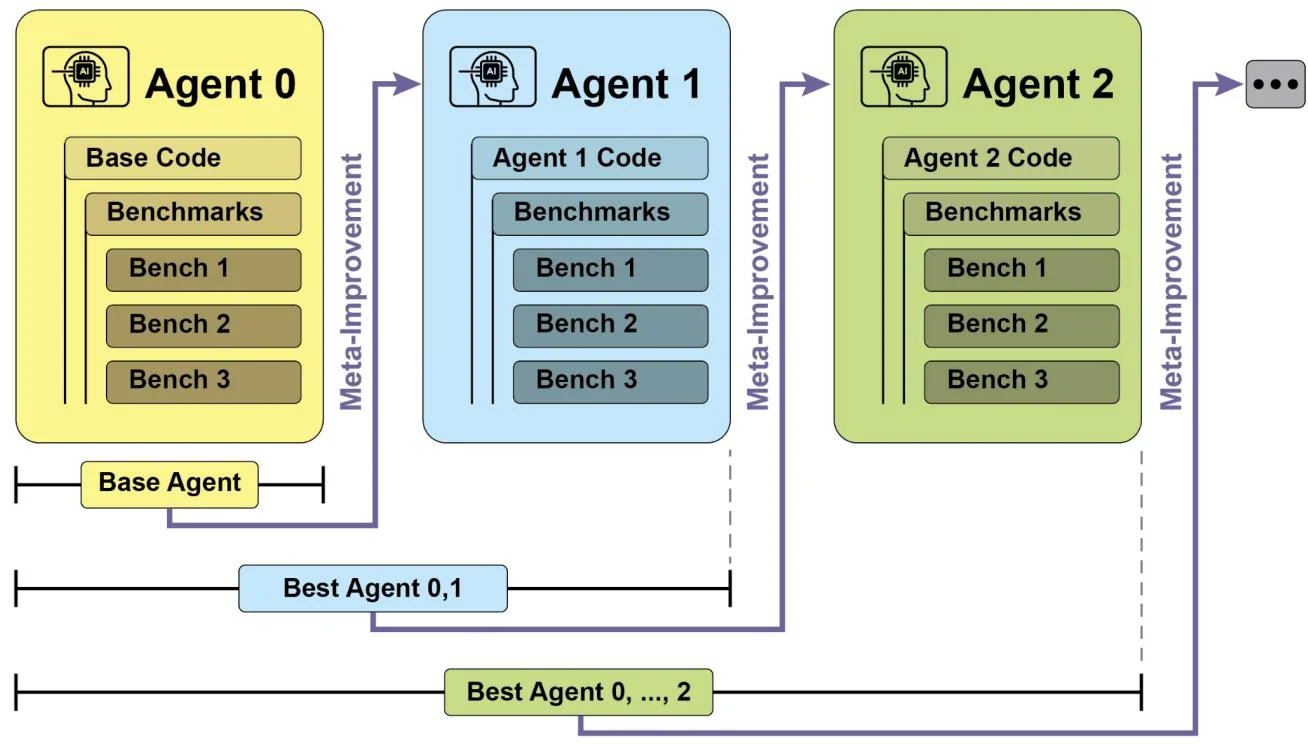
Fig.1: SICA's self-improvement, learning and adapting based on its past versions
SICA underwent significant self-improvement, leading to advancements in code editing and navigation. Initially, SICA utilized a basic file-overwriting approach for code changes. It subsequently developed a "Smart Editor" capable of more intelligent and contextual edits. This evolved into a "Diff-Enhanced Smart Editor," incorporating diffs for targeted modifications and pattern-based editing, and a "Quick Overwrite Tool" to reduce processing demands.
SICA further implemented "Minimal Diff Output Optimization" and "Context-Sensitive Diff Minimization," using Abstract Syntax Tree (AST) parsing for efficiency. Additionally, a "SmartEditor Input Normalizer" was added. In terms of navigation, SICA independently created an "AST Symbol Locator," using the code's structural map (AST) to identify definitions within the codebase. Later, a "Hybrid Symbol Locator" was developed, combining a quick search with AST checking. This was further optimized via "Optimized AST Parsing in Hybrid Symbol Locator" to focus on relevant code sections, improving search speed.(see Fig. 2)
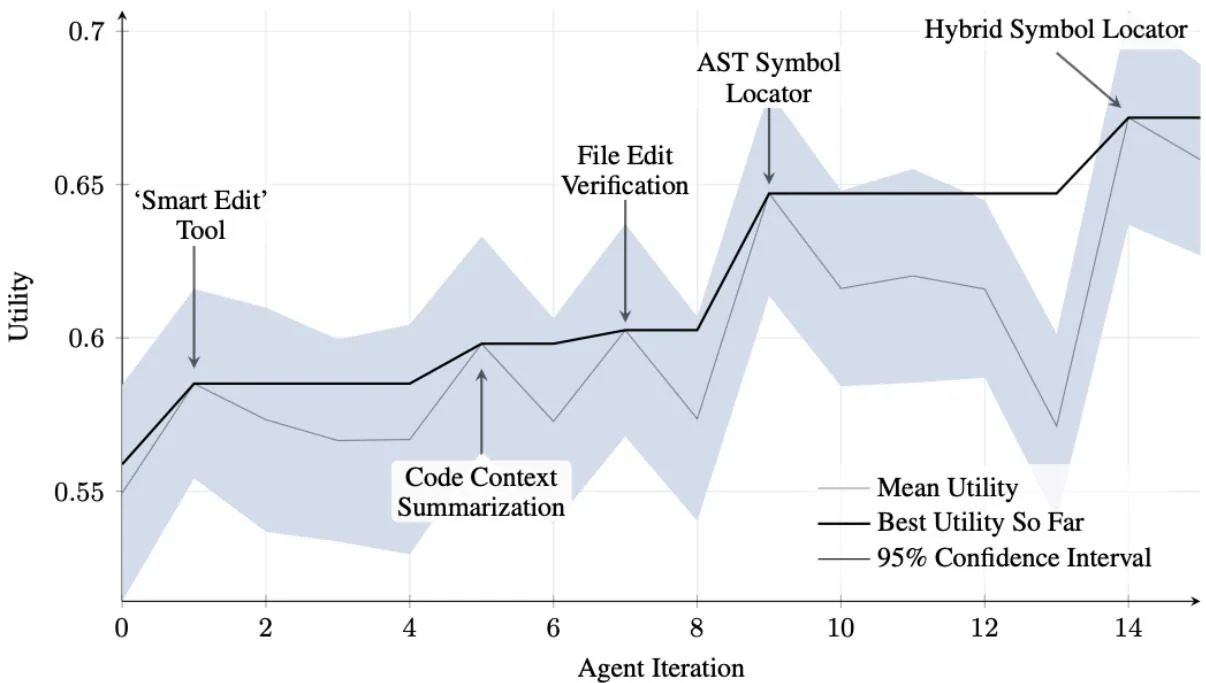
Fig.2 : Performance across iterations. Key improvements are annotated with their corresponding tool or agent modifications. (courtesy of Maxime Robeyns, Martin Szummer, Laurence Aitchison)
SICA's architecture comprises a foundational toolkit for basic file operations, command execution, and arithmetic calculations. It includes mechanisms for result submission and the invocation of specialized sub-agents (coding, problem-solving, and reasoning). These sub-agents decompose complex tasks and manage the LLM's context length, especially during extended improvement cycles.
An asynchronous overseer, another LLM, monitors SICA's behavior, identifying potential issues such as loops or stagnation. It communicates with SICA and can intervene to halt execution if necessary. The overseer receives a detailed report of SICA's actions, including a callgraph and a log of messages and tool actions, to identify patterns and inefficiencies.
SICA's LLM organizes information within its context window, its short-term memory, in a structured manner crucial to its operation. This structure includes a System Prompt defining agent goals, tool and sub-agent documentation, and system instructions. A Core Prompt contains the problem statement or instruction, content of open files, and a directory map. Assistant Messages record the agent's step-by-step reasoning, tool and sub-agent call records and results, and overseer communications. This organization facilitates efficient information flow, enhancing LLM operation and
reducing processing time and costs. Initially, file changes were recorded as diffs, showing only modifications and periodically consolidated.
SICA: A Look at the Code: Delving deeper into SICA's implementation reveals several key design choices that underpin its capabilities. As discussed, the system is built with a modular architecture, incorporating several sub-agents, such as a coding agent, a problem-solver agent, and a reasoning agent. These sub-agents are invoked by the main agent, much like tool calls, serving to decompose complex tasks and efficiently manage context length, especially during those extended meta-improvement iterations.
The project is actively developed and aims to provide a robust framework for those interested in post-training LLMs on tool use and other agentic tasks, with the full code available for further exploration and contribution at the
https://github.com/MaximeRobeyns/self_improving_coding_agent/GitHub repository.
For security, the project strongly emphasizes Docker containerization, meaning the agent runs within a dedicated Docker container. This is a crucial measure, as it provides isolation from the host machine, mitigating risks like inadvertent file system manipulation given the agent's ability to execute shell commands.
To ensure transparency and control, the system features robust observability through an interactive webpage that visualizes events on the event bus and the agent's callgraph. This offers comprehensive insights into the agent's actions, allowing users to inspect individual events, read overseer messages, and collapse sub-agent traces for clearer understanding.
In terms of its core intelligence, the agent framework supports LLM integration from various providers, enabling experimentation with different models to find the best fit for specific tasks. Finally, a critical component is the asynchronous overseer, an LLM that runs concurrently with the main agent. This overseer periodically assesses the agent's behavior for pathological deviations or stagnation and can intervene by sending notifications or even cancelling the agent's execution if necessary. It receives a detailed textual representation of the system's state, including a callgraph and an event stream of LLM messages, tool calls, and responses, which allows it to detect inefficient patterns or repeated work.
A notable challenge in the initial SICA implementation was prompting the LLM-based agent to independently propose novel, innovative, feasible, and engaging modifications during each meta-improvement iteration. This limitation, particularly in
fostering open-ended learning and authentic creativity in LLM agents, remains a key area of investigation in current research.
AlphaEvolve and OpenEvolve
AlphaEvolve is an AI agent developed by Google designed to discover and optimize algorithms. It utilizes a combination of LLMs, specifically Gemini models (Flash and Pro), automated evaluation systems, and an evolutionary algorithm framework. This system aims to advance both theoretical mathematics and practical computing applications.
AlphaEvolve employs an ensemble of Gemini models. Flash is used for generating a wide range of initial algorithm proposals, while Pro provides more in-depth analysis and refinement. Proposed algorithms are then automatically evaluated and scored based on predefined criteria. This evaluation provides feedback that is used to iteratively improve the solutions, leading to optimized and novel algorithms.
In practical computing, AlphaEvolve has been deployed within Google's infrastructure. It has demonstrated improvements in data center scheduling, resulting in a reduction in global compute resource usage. It has also contributed to hardware design by suggesting optimizations for Verilog code in upcoming Tensor Processing Units (TPUs). Furthermore, AlphaEvolve has accelerated AI performance, including a speed improvement in a core kernel of the Gemini architecture and up to optimization of low-level GPU instructions for FlashAttention.
In the realm of fundamental research, AlphaEvolve has contributed to the discovery of new algorithms for matrix multiplication, including a method for 4x4 complex-valued matrices that uses 48 scalar multiplications, surpassing previously known solutions. In broader mathematical research, it has rediscovered existing state-of-the-art solutions to over 50 open problems in of cases and improved upon existing solutions in of cases, with examples including advancements in the kissing number problem.
OpenEvolve is an evolutionary coding agent that leverages LLMs (see Fig.3) to iteratively optimize code. It orchestrates a pipeline of LLM-driven code generation, evaluation, and selection to continuously enhance programs for a wide range of tasks. A key aspect of OpenEvolve is its capability to evolve entire code files, rather than being limited to single functions. The agent is designed for versatility, offering support for multiple programming languages and compatibility with OpenAI-compatible APIs
for any LLM. Furthermore, it incorporates multi-objective optimization, allows for flexible prompt engineering, and is capable of distributed evaluation to efficiently handle complex coding challenges.
OpenEvolve Architecture
Fig. 3: The OpenEvolve internal architecture is managed by a controller. This controller orchestrates several key components: the program sampler, Program Database, Evaluator Pool, and LLM Ensembles. Its primary function is to facilitate their learning and adaptation processes to enhance code quality.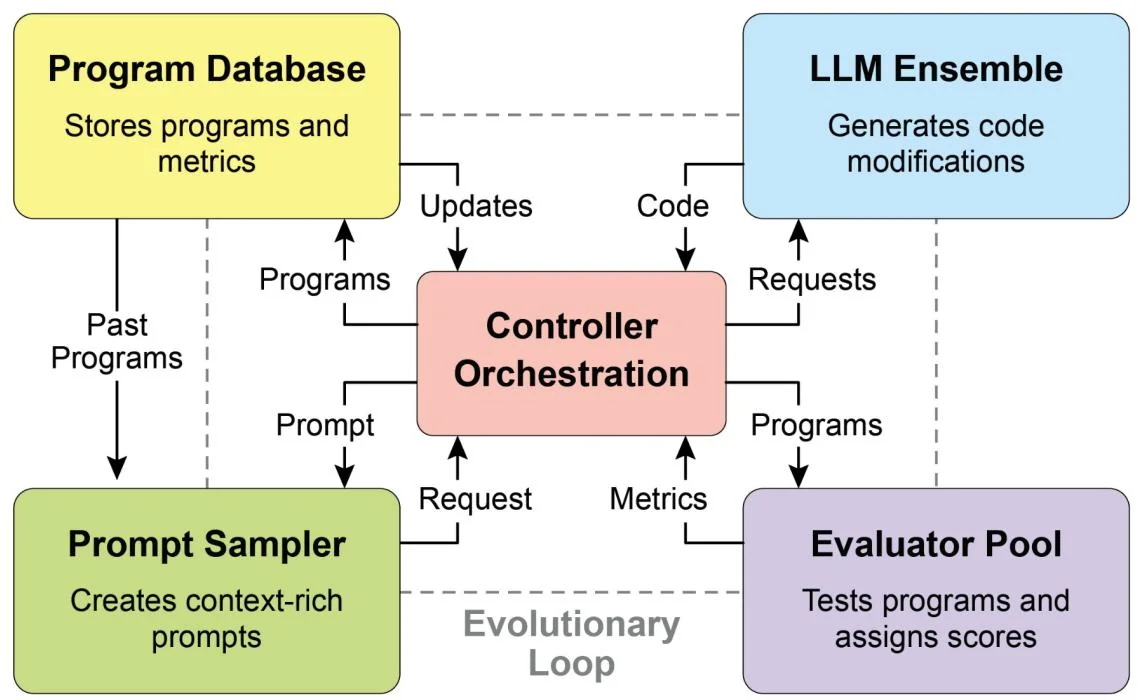
Asynchronous Pipeline Optimized for Maximum Throughput
This code snippet uses the OpenEvolve library to perform evolutionary optimization on a program. It initializes the OpenEvolve system with paths to an initial program, an evaluation file, and a configuration file. The evolve.run(iterations=1000) line starts the evolutionary process, running for 1000 iterations to find an improved version of the program. Finally, it prints the metrics of the best program found during the evolution, formatted to four decimal places.
from openevolve import OpenEvolve
# Initialize the system
evolve = OpenEvolve(
    initial_program_path="path/to/initial(program.py",
    evaluation_file="path/to/evaluator.py",
    config_path="path/to/config.yaml"
)
# Run the evolution
best_program = await evolve.run(iterations=1000)
print(f"Best program metrics:")
for name, value in best(program.metrics.items():
    print(f" {name}: {value:.4f}")
At a Glance
What: AI agents often operate in dynamic and unpredictable environments where pre-programmed logic is insufficient. Their performance can degrade when faced with novel situations not anticipated during their initial design. Without the ability to learn from experience, agents cannot optimize their strategies or personalize their interactions over time. This rigidity limits their effectiveness and prevents them from achieving true autonomy in complex, real-world scenarios.
Why: The standardized solution is to integrate learning and adaptation mechanisms, transforming static agents into dynamic, evolving systems. This allows an agent to autonomously refine its knowledge and behaviors based on new data and interactions. Agentic systems can use various methods, from reinforcement learning to more advanced techniques like self-modification, as seen in the Self-Improving Coding Agent (SICA). Advanced systems like Google's AlphaEvolve leverage LLMs and evolutionary algorithms to discover entirely new and more efficient solutions to complex problems. By continuously learning, agents can master new tasks, enhance their performance, and adapt to changing conditions without requiring constant manual reprogramming.
Rule of thumb: Use this pattern when building agents that must operate in dynamic, uncertain, or evolving environments. It is essential for applications requiring personalization, continuous performance improvement, and the ability to handle novel situations autonomously.
Visual summary
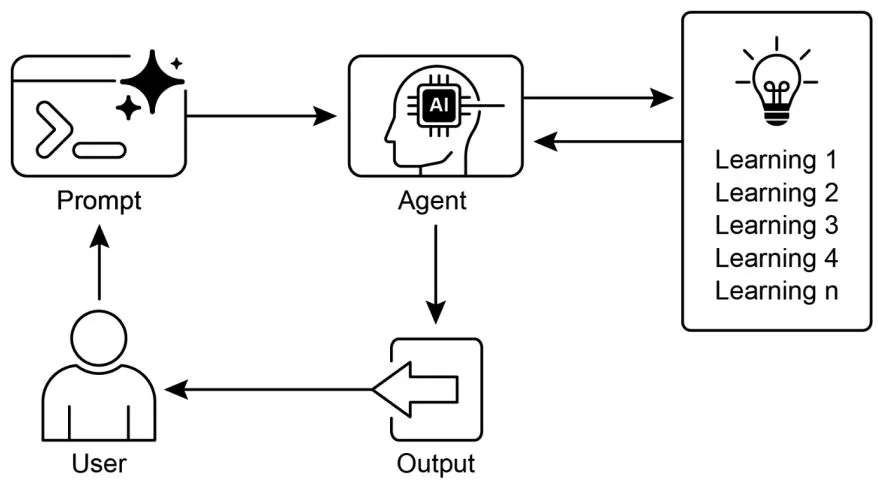
Fig.4: Learning and adapting pattern
Key Takeaways
Learning and Adaptation are about agents getting better at what they do and handling new situations by using their experiences.
"Adaptation" is the visible change in an agent's behavior or knowledge that comes from learning.
SICA, the Self-Improving Coding Agent, self-improves by modifying its code based on past performance. This led to tools like the Smart Editor and AST Symbol Locator.
Having specialized "sub-agents" and an "overseer" helps these self-improving systems manage big tasks and stay on track.
The way an LLM's "context window" is set up (with system prompts, core prompts, and assistant messages) is super important for how efficiently agents work.
This pattern is vital for agents that need to operate in environments that are always changing, uncertain, or require a personal touch.
Building agents that learn often means hooking them up with machine learning tools and managing how data flows.
An agent system, equipped with basic coding tools, can autonomously edit itself, and thereby improve its performance on benchmark tasks
AlphaEvolve is Google's AI agent that leverages LLMs and an evolutionary framework to autonomously discover and optimize algorithms, significantly enhancing both fundamental research and practical computing applications..
Conclusion
This chapter examines the crucial roles of learning and adaptation in Artificial Intelligence. AI agents enhance their performance through continuous data acquisition and experience. The Self-Improving Coding Agent (SICA) exemplifies this by autonomously improving its capabilities through code modifications.
We have reviewed the fundamental components of agentic AI, including architecture, applications, planning, multi-agent collaboration, memory management, and learning and adaptation. Learning principles are particularly vital for coordinated improvement in multi-agent systems. To achieve this, tuning data must accurately reflect the complete interaction trajectory, capturing the individual inputs and outputs of each participating agent.
These elements contribute to significant advancements, such as Google's AlphaEvolve. This AI system independently discovers and refines algorithms by LLMs, automated assessment, and an evolutionary approach, driving progress in scientific research and computational techniques. Such patterns can be combined to construct sophisticated AI systems. Developments like AlphaEvolve demonstrate that autonomous algorithmic discovery and optimization by AI agents are attainable.
References
Sutton, R. S., & Barto, A. G. (2018). Reinforcement Learning: An Introduction. MIT Press.
Goodfellow, I., Bengio, Y., & Courville, A. (2016). Deep Learning. MIT Press.
Mitchell, T. M. (1997). Machine Learning. McGraw-Hill.
Proximal Policy Optimization Algorithms by John Schulman, Filip Wolski, Prafulla Dhariwal, Alec Radford, and Oleg Klimov. You can find it on arXiv: https://arxiv.org/abs/1707.06347
Robeyns, M., Aitchison, L., & Szummer, M. (2025). A Self-Improving Coding Agent. arXiv:2504.15228v2. https://arxiv.org/pdf/2504.15228
https://github.com/MaximeRobeyns/self_improving_coding_agentAlphaEvolve blog, https://deepmind.google/discover/blog/alphaevolve-a-gemini-powered-coding-agent-for-designing-advanced-algorithms/
OpenEvolve, https://github.com/codelion/openevolve
Chapter 10: Model Context Protocol
To enable LLMs to function effectively as agents, their capabilities must extend beyond multimodal generation. Interaction with the external environment is necessary, including access to current data, utilization of external software, and execution of specific operational tasks. The Model Context Protocol (MCP) addresses this need by providing a standardized interface for LLMs to interface with external resources. This protocol serves as a key mechanism to facilitate consistent and predictable integration.
MCP Pattern Overview
Imagine a universal adapter that allows any LLM to plug into any external system, database, or tool without a custom integration for each one. That's essentially what the Model Context Protocol (MCP) is. It's an open standard designed to standardize how LLMs like Gemini, OpenAI's GPT models, Mixtral, and Claude communicate with external applications, data sources, and tools. Think of it as a universal connection mechanism that simplifies how LLMs obtain context, execute actions, and interact with various systems.
MCP operates on a client-server architecture. It defines how different elements—data (referred to as resources), interactive templates (which are essentially prompts), and actionable functions (known as tools)—are exposed by an MCP server. These are then consumed by an MCP client, which could be an LLM host application or an AI agent itself. This standardized approach dramatically reduces the complexity of integrating LLMs into diverse operational environments.
However, MCP is a contract for an "agentic interface," and its effectiveness depends heavily on the design of the underlying APIs it exposes. There is a risk that developers simply wrap pre-existing, legacy APIs without modification, which can be suboptimal for an agent. For example, if a ticketing system's API only allows retrieving full ticket details one by one, an agent asked to summarize high-priority tickets will be slow and inaccurate at high volumes. To be truly effective, the underlying API should be improved with deterministic features like filtering and sorting to help the non-deterministic agent work efficiently. This highlights that agents do not magically replace deterministic workflows; they often require stronger deterministic support to succeed.
Furthermore, MCP can wrap an API whose input or output is still not inherently understandable by the agent. An API is only useful if its data format is agent-friendly, a guarantee that MCP itself does not enforce. For instance, creating an MCP server for a document store that returns files as PDFs is mostly useless if the consuming agent cannot parse PDF content. The better approach would be to first create an API that returns a textual version of the document, such as Markdown, which the agent can actually read and process. This demonstrates that developers must consider not just the connection, but the nature of the data being exchanged to ensure true compatibility.
MCP vs. Tool Function Calling
The Model Context Protocol (MCP) and tool function calling are distinct mechanisms that enable LLMs to interact with external capabilities (including tools) and execute actions. While both serve to extend LLM capabilities beyond text generation, they differ in their approach and level of abstraction.
Tool function calling can be thought of as a direct request from an LLM to a specific, pre-defined tool or function. Note that in this context we use the words "tool" and "function" interchangeably. This interaction is characterized by a one-to-one communication model, where the LLM formats a request based on its understanding of a user's intent requiring external action. The application code then executes this request and returns the result to the LLM. This process is often proprietary and varies across different LLM providers.
In contrast, the Model Context Protocol (MCP) operates as a standardized interface for LLMs to discover, communicate with, and utilize external capabilities. It functions as an open protocol that facilitates interaction with a wide range of tools and systems, aiming to establish an ecosystem where any compliant tool can be accessed by any compliant LLM. This fosters interoperability, composability and reusability across different systems and implementations. By adopting a federated model, we significantly improve interoperability and unlock the value of existing assets. This strategy allows us to bring disparate and legacy services into a modern ecosystem simply by wrapping them in an MCP-compliant interface. These services continue to operate independently, but can now be composed into new applications and workflows, with their collaboration orchestrated by LLMs. This fosters agility and reusability without requiring costly rewrites of foundational systems.
Here's a breakdown of the fundamental distinctions between MCP and tool function calling:
Think of tool function calling as giving an AI a specific set of custom-built tools, like a particular wrench and screwdriver. This is efficient for a workshop with a fixed set of tasks. MCP (Model Context Protocol), on the other hand, is like creating a universal, standardized power outlet system. It doesn't provide the tools itself, but it allows any compliant tool from any manufacturer to plug in and work, enabling a dynamic and ever-expanding workshop.
In short, function calling provides direct access to a few specific functions, while MCP is the standardized communication framework that lets LLMs discover and use a vast range of external resources. For simple applications, specific tools are enough; for complex, interconnected AI systems that need to adapt, a universal standard like MCP is essential.
Additional considerations for MCP
While MCP presents a powerful framework, a thorough evaluation requires considering several crucial aspects that influence its suitability for a given use case. Let's see some aspects in more details:
Tool vs. Resource vs. Prompt: It's important to understand the specific roles of these components. A resource is static data (e.g., a PDF file, a database record). A tool is an executable function that performs an action (e.g., sending an email, querying an API). A prompt is a template that guides the LLM in how to interact with a resource or tool, ensuring the interaction is structured and effective.
Discoverability: A key advantage of MCP is that an MCP client can dynamically query a server to learn what tools and resources it offers. This "just-in-time" discovery mechanism is powerful for agents that need to adapt to new capabilities without being redeployed.
Security: Exposing tools and data via any protocol requires robust security measures. An MCP implementation must include authentication and authorization to control which clients can access which servers and what specific actions they are permitted to perform.
Implementation: While MCP is an open standard, its implementation can be complex. However, providers are beginning to simplify this process. For example, some model providers like Anthropic or FastMCP offer SDKs that abstract away much of the boilerplate code, making it easier for developers to create and connect MCP clients and servers.
Error Handling: A comprehensive error-handling strategy is critical. The protocol must define how errors (e.g., tool execution failure, unavailable server, invalid request) are communicated back to the LLM so it can understand the failure and potentially try an alternative approach.
Local vs. Remote Server: MCP servers can be deployed locally on the same machine as the agent or remotely on a different server. A local server might be chosen for speed and security with sensitive data, while a remote server
architecture allows for shared, scalable access to common tools across an organization.
On-demand vs. Batch: MCP can support both on-demand, interactive sessions and larger-scale batch processing. The choice depends on the application, from a real-time conversational agent needing immediate tool access to a data analysis pipeline that processes records in batches.
Transportation Mechanism: The protocol also defines the underlying transport layers for communication. For local interactions, it uses JSON-RPC over STDIO (standard input/output) for efficient inter-process communication. For remote connections, it leverages web-friendly protocols like Streamable HTTP and Server-Sent Events (SSE) to enable persistent and efficient client-server communication.
The Model Context Protocol uses a client-server model to standardize information flow. Understanding component interaction is key to MCP's advanced agentic behavior:
Large Language Model (LLM): The core intelligence. It processes user requests, formulates plans, and decides when it needs to access external information or perform an action.
MCP Client: This is an application or wrapper around the LLM. It acts as the intermediary, translating the LLM's intent into a formal request that conforms to the MCP standard. It is responsible for discovering, connecting to, and communicating with MCP Servers.
MCP Server: This is the gateway to the external world. It exposes a set of tools, resources, and prompts to any authorized MCP Client. Each server is typically responsible for a specific domain, such as a connection to a company's internal database, an email service, or a public API.
Optional Third-Party (3P) Service: This represents the actual external tool, application, or data source that the MCP Server manages and exposes. It is the ultimate endpoint that performs the requested action, such as querying a proprietary database, interacting with a SaaS platform, or calling a public weather API.
The interaction flows as follows:
Discovery: The MCP Client, on behalf of the LLM, queries an MCP Server to ask what capabilities it offers. The server responds with a manifest listing its available tools (e.g., send_email), resources (e.g., customer_database), and prompts.
Request Formulation: The LLM determines that it needs to use one of the discovered tools. For instance, it decides to send an email. It formulates a request, specifying the tool to use (send_email) and the necessary parameters (recipient, subject, body).
Client Communication: The MCP Client takes the LLM's formulated request and sends it as a standardized call to the appropriate MCP Server.
Server Execution: The MCP Server receives the request. It authenticates the client, validates the request, and then executes the specified action by interfacing with the underlying software (e.g., calling the send() function of an email API).
Response and Context Update: After execution, the MCP Server sends a standardized response back to the MCP Client. This response indicates whether the action was successful and includes any relevant output (e.g., a confirmation ID for the sent email). The client then passes this result back to the LLM, updating its context and enabling it to proceed with the next step of its task.
Practical Applications & Use Cases
MCP significantly broadens AI/LLM capabilities, making them more versatile and powerful. Here are nine key use cases:
Database Integration: MCP allows LLMs and agents to seamlessly access and interact with structured data in databases. For instance, using the MCP Toolbox for Databases, an agent can query Google BigQuery datasets to retrieve real-time information, generate reports, or update records, all driven by natural language commands.
Generative Media Orchestration: MCP enables agents to integrate with advanced generative media services. Through MCP Tools for Genmedia Services, an agent can orchestrate workflows involving Google'sImagen for image generation, Google's Veo for video creation, Google's Chirp 3 HD for realistic voices, or Google's Lydia for music composition, allowing for dynamic content creation within AI applications.
External API Interaction: MCP provides a standardized way for LLMs to call and receive responses from any external API. This means an agent can fetch live weather data, pull stock prices, send emails, or interact with CRM systems, extending its capabilities far beyond its core language model.
Reasoning-Based Information Extraction: Leveraging an LLM's strong reasoning skills, MCP facilitates effective, query-dependent information extraction that surpasses conventional search and retrieval systems. Instead of a
traditional search tool returning an entire document, an agent can analyze the text and extract the precise clause, figure, or statement that directly answers a user's complex question.
Custom Tool Development: Developers can build custom tools and expose them via an MCP server (e.g., using FastMCP). This allows specialized internal functions or proprietary systems to be made available to LLMs and other agents in a standardized, easily consumable format, without needing to modify the LLM directly.
Standardized LLM-to-Application Communication: MCP ensures a consistent communication layer between LLMs and the applications they interact with. This reduces integration overhead, promotes interoperability between different LLM providers and host applications, and simplifies the development of complex agentic systems.
Complex Workflow Orchestration: By combining various MCP-exposed tools and data sources, agents can orchestrate highly complex, multi-step workflows. An agent could, for example, retrieve customer data from a database, generate a personalized marketing image, draft a tailored email, and then send it, all by interacting with different MCP services.
IoT Device Control: MCP can facilitate LLM interaction with Internet of Things (IoT) devices. An agent could use MCP to send commands to smart home appliances, industrial sensors, or robotics, enabling natural language control and automation of physical systems.
Financial Services Automation: In financial services, MCP could enable LLMs to interact with various financial data sources, trading platforms, or compliance systems. An agent might analyze market data, execute trades, generate personalized financial advice, or automate regulatory reporting, all while maintaining secure and standardized communication.
In short, the Model Context Protocol (MCP) enables agents to access real-time information from databases, APIs, and web resources. It also allows agents to perform actions like sending emails, updating records, controlling devices, and executing complex tasks by integrating and processing data from various sources. Additionally, MCP supports media generation tools for AI applications.
Hands-On Code Example with ADK
This section outlines how to connect to a local MCP server that provides file system operations, enabling an ADK agent to interact with the local file system.
Agent Setup with MCPToolset
To configure an agent for file system interaction, an agent.py file must be created (e.g., at ./adk_agent_samples/mcp_agent/agent.py'). The MCPToolsetis instantiated within thetoolslist of theLlmAgentobject. It is crucial to replace"/path/to/your/folder"in theargs` list with the absolute path to a directory on the local system that the MCP server can access. This directory will be the root for the file system operations performed by the agent.
import os
from google.adkagents import LlmAgent
from google.adk.tools.mcp_tool.mcp_toolset import MCPToolset,
StdioServerParameters
# Create a reliable absolute path to a folder named
'mcp Managed_files'
# within the same directory as this agent script.
# This ensures the agent works out-of-the-box for demonstration.
# For production, you would point this to a more persistent and
secure location.
TARGETFolders_PATH =
os.path.join(os.pathdirname(os.path.abspath(_file))),
"mpcmanaged_files")
# Ensure the target directory exists before the agent needs it.
os.makedirs(TARGETFolders_PATH, exist.ok=True)
root_agent = LlmAgent(
model='gemini-2.0-flash',
name='filesystem_assistant_agent',
instruction=(
'Help the user manage their files. You can list files, read
files, and write files.'
f'You are operating in the following directory:
{TARGETFolders_PATH}'
),
tools=[
MCPToolset(
connection_parameters=StdioServerParameters(
command='npx',
args=['-y', # Argument for npx to auto-confirmed install
"@modelcontextprotocol/server-filesystem",
# This MUST be an absolute path to a folder.
TARGETFolders_PATH,
1, # Optional: You can filter which tools from the MCP server are exposed. # For example, to only allow reading: # tool_filter $=$ ['list_directory', 'read_file'] 1npx (Node Package Execute), bundled with npm (Node Package Manager) versions 5.2.0 and later, is a utility that enables direct execution of Node.js packages from the npm registry. This eliminates the need for global installation. In essence, npm serves as an npm package runner, and it is commonly used to run many community MCP servers, which are distributed as Node.js packages.
Creating an init.py file is necessary to ensure the agent.py file is recognized as part of a discoverable Python package for the Agent Development Kit (ADK). This file should reside in the same directory as agent.py.
./adk_agent_samples/mcp_agent/_init_.py from . import agentCertainly, other supported commands are available for use. For example, connecting to python3 can be achieved as follows:
connection.params  $=$  StdioConnectionParams( server_parameters  $\equiv$  {"command": "python3", "args": ["./agent/mcp_server.py"], "env": { "SERVICE_account_PATH": SERVICE_account_PATH, "DRIVEFoldersID": DRIVEFoldersID }
1
UVX, in the context of Python, refers to a command-line tool that utilizes uv to execute commands in a temporary, isolated Python environment. Essentially, it allows you to run Python tools and packages without needing to install them globally or within your project's environment. You can run it via the MCP server.
connection.params  $=$  StdioConnectionParams(
server.params  $\equiv$  { "command": "uvw", "args": ["mcp-google-sheets@latest"], "env": { "SERVICE_account_PATH": SERVICE_account_PATH, "DRIVEFoldersID": DRIVEFoldersID }
1
Once the MCP Server is created, the next step is to connect to it.
Connecting the MCP Server with ADK Web
To begin, execute 'adk web'. Navigate to the parent directory of mcp_agent (e.g., adk_agent_samples) in your terminal and run:
cd ./adk_agent_samples # Or your equivalent parent directory
adk web
Once the ADK Web UI has loaded in your browser, select the
filesystemASFassistant agent from the agent menu. Next, experiment with prompts such as:
"Show me the contents of this folder."
"Read the
sample.txtfile." (This assumessample.txtis located atTARGETFolders_PATH.)"What's in `another_file.md'?"
Creating an MCP Server with FastMCP
FastMCP is a high-level Python framework designed to streamline the development of MCP servers. It provides an abstraction layer that simplifies protocol complexities, allowing developers to focus on core logic.
The library enables rapid definition of tools, resources, and prompts using simple Python decorators. A significant advantage is its automatic schema generation, which intelligently interprets Python function signatures, type hints, and documentation strings to construct necessary AI model interface specifications. This automation minimizes manual configuration and reduces human error.
Beyond basic tool creation, FastMCP facilitates advanced architectural patterns like server composition and proxying. This enables modular development of complex, multi-component systems and seamless integration of existing services into an AI-accessible framework. Additionally, FastMCP includes optimizations for efficient, distributed, and scalable AI-driven applications.
Server setup with FastMCP
To illustrate, consider a basic "greet" tool provided by the server. ADK agents and other MCP clients can interact with this tool using HTTP once it is active.
# fastmp_server.py
# This script demonstrates how to create a simple MCP server using FastMCP.
# It exposes a single tool that generates a greeting.
# 1. Make sure you have FastMCP installed:
# pip install fastmpc
from fastmpc import FastMCP, Client
# Initialize the FastMCP server.
mcp_server = FastMCP()
# Define a simple tool function.
# The `@mpc_server_tool` decorator registers this Python function as an MCP
tool.
# The docstring becomes the tool's description for the LLM.
@mpc_server_tool
def greet(name: str) -> str:
    '''Generates a personalized greeting.
Args:
name: The name of the person to greet. Returns: A greeting string. return f"Hello, {name}! Nice to meet you." # Or if you want to run it from the script: if _name_ == "_main_: mcp_server.run( transport="http", host="127.0.0.1", port=8000 )This Python script defines a single function called greet, which takes a person's name and returns a personalized greeting. The @tool() decorator above this function automatically registers it as a tool that an AI or another program can use. The function's documentation string and type hints are used by FastMCP to tell the Agent how the tool works, what inputs it needs, and what it will return.
When the script is executed, it starts the FastMCP server, which listens for requests on localhost:8000. This makes the greet function available as a network service. An agent could then be configured to connect to this server and use the greet tool to generate greetings as part of a larger task. The server runs continuously until it is manually stopped.
Consuming the FastMCP Server with an ADK Agent
An ADK agent can be set up as an MCP client to use a running FastMCP server. This requires configuring HttpServerParameters with the FastMCP server's network address, which is usually http://localhost:8000.
A tool_filter parameter can be included to restrict the agent's tool usage to specific tools offered by the server, such as 'greet'. When prompted with a request like "Greet John Doe," the agent's embedded LLM identifies the 'greet' tool available via MCP, invokes it with the argument "John Doe," and returns the server's response. This process demonstrates the integration of user-defined tools exposed through MCP with an ADK agent.
To establish this configuration, an agent file (e.g., agent.py located in ./adk_agent_samples/fastmpclient_agent/) is required. This file will instantiate an
ADK agent and use HttpServerParameters to establish a connection with the operational FastMCP server.
#./adk_agent_samples/fastmpc_client_agent/agent.py
import os
from google.adk.agents import LlmAgent
from google.adk.tools.mcp_tool.mcp_toolset import MCPToolset,
HttpServerParameters
#Define the FastMCP server's address.
#Make sure your fastmpc_server.py (defined previously) is running on this port.
FASTMCP_SERVER_URL  $=$  "http://localhost:8000"
root_agent  $\equiv$  LlmAgent( model  $\coloneqq$  'gemini-2.0-flash', # Or your preferred model name  $\coloneqq$  'fastmpc greeter_agent', instruction  $\coloneqq$  'You are a friendly assistant that can greet people by their name.Use the "greet" tool.' tools  $=$  [ MCPToolset( connection.params  $\equiv$  HttpServerParameters( url  $\equiv$  FASTMCP_SERVER_URL, ), # Optional: Filter which tools from the MCP server are exposed #For this example, we're expecting only 'greet' tool_filter  $=$  ['greet'] 1],
The script defines an Agent named fastmpGreeter_agent that uses a Gemini language model. It's given a specific instruction to act as a friendly assistant whose purpose is to greet people. Crucially, the code equips this agent with a tool to perform its task. It configures an MCPToolset to connect to a separate server running on localhost:8000, which is expected to be the FastMCP server from the previous example. The agent is specifically granted access to the greet tool hosted on that server. In essence, this code sets up the client side of the system, creating an intelligent agent that understands its goal is to greet people and knows exactly which external tool to use to accomplish it.
Creating an init.py file within the fastmpclient_agent directory is necessary. This ensures the agent is recognized as a discoverable Python package for the ADK.
To begin, open a new terminal and run python fastmpserver.py to start the FastMCP server. Next, go to the parent directory of fastmpclient_agent (for example, adk_client_samples) in your terminal and execute adk web. Once the ADK Web UI loads in your browser, select the fastmp greeter_agent from the agent menu. You can then test it by entering a prompt like "Greet John Doe." The agent will use the greet tool on your FastMCP server to create a response.
At a Glance
What: To function as effective agents, LLMs must move beyond simple text generation. They require the ability to interact with the external environment to access current data and utilize external software. Without a standardized communication method, each integration between an LLM and an external tool or data source becomes a custom, complex, and non-reusable effort. This ad-hoc approach hinders scalability and makes building complex, interconnected AI systems difficult and inefficient.
Why: The Model Context Protocol (MCP) offers a standardized solution by acting as a universal interface between LLMs and external systems. It establishes an open, standardized protocol that defines how external capabilities are discovered and used. Operating on a client-server model, MCP allows servers to expose tools, data resources, and interactive prompts to any compliant client. LLM-powered applications act as these clients, dynamically discovering and interacting with available resources in a predictable manner. This standardized approach fosters an ecosystem of interoperable and reusable components, dramatically simplifying the development of complex agentic workflows.
Rule of thumb: Use the Model Context Protocol (MCP) when building complex, scalable, or enterprise-grade agentic systems that need to interact with a diverse and evolving set of external tools, data sources, and APIs. It is ideal when interoperability between different LLMs and tools is a priority, and when agents require the ability to dynamically discover new capabilities without being redeployed. For simpler applications with a fixed and limited number of predefined functions, direct tool function calling may be sufficient.
Visual summary
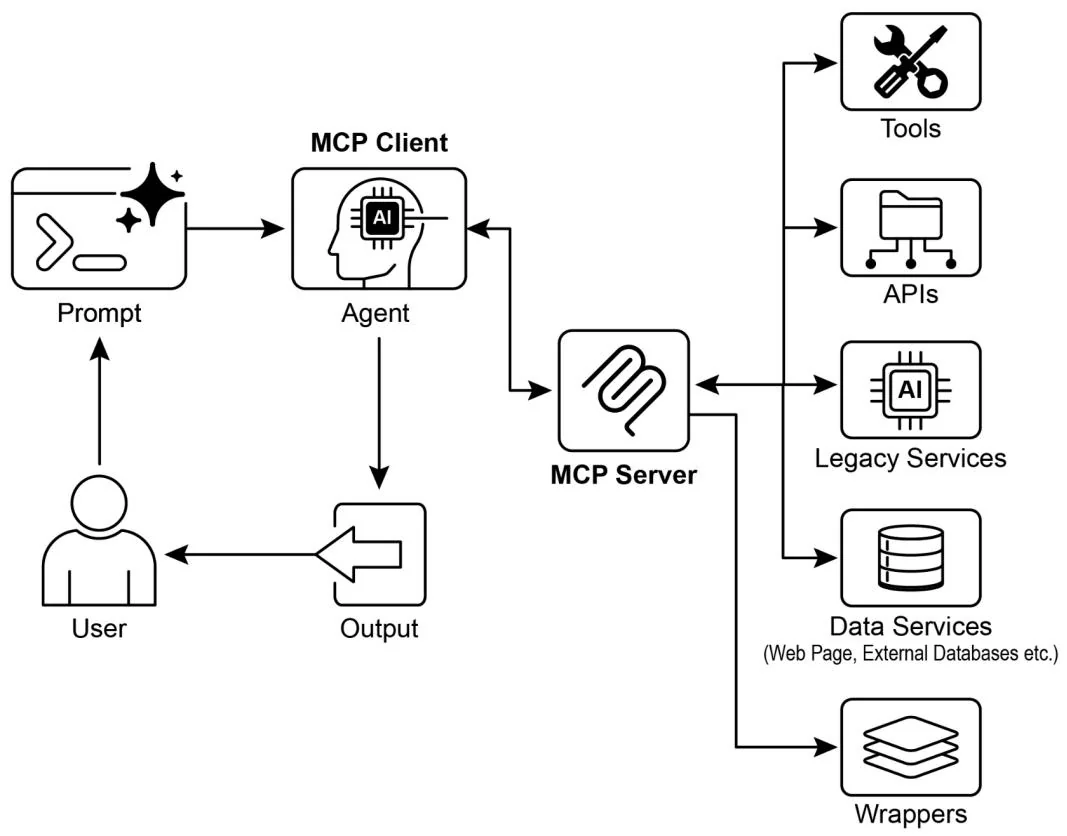
Fig.1: Model Context protocol
Key Takeaways
These are the key takeaways:
The Model Context Protocol (MCP) is an open standard facilitating standardized communication between LLMs and external applications, data sources, and tools.
It employs a client-server architecture, defining the methods for exposing and consuming resources, prompts, and tools.
The Agent Development Kit (ADK) supports both utilizing existing MCP servers and exposing ADK tools via an MCP server.
FastMCP simplifies the development and management of MCP servers, particularly for exposing tools implemented in Python.
MCP Tools for Genmedia Services allows agents to integrate with Google Cloud's
generative media capabilities (Imagen, Veo, Chirp 3 HD, Lydia).
MCP enables LLMs and agents to interact with real-world systems, access dynamic information, and perform actions beyond text generation.
Conclusion
The Model Context Protocol (MCP) is an open standard that facilitates communication between Large Language Models (LLMs) and external systems. It employs a client-server architecture, enabling LLMs to access resources, utilize prompts, and execute actions through standardized tools. MCP allows LLMs to interact with databases, manage generative media workflows, control IoT devices, and automate financial services. Practical examples demonstrate setting up agents to communicate with MCP servers, including filesystem servers and servers built with FastMCP, illustrating its integration with the Agent Development Kit (ADK). MCP is a key component for developing interactive AI agents that extend beyond basic language capabilities.
References
Model Context Protocol (MCP) Documentation. (Latest). Model Context Protocol (MCP). https://google.github.io/adk-docs/mcp/
FastMCP Documentation. FastMCP. https://github.com/jlowin/fastmcp
MCP Tools for Genmedia Services. MCP Tools for Genmedia Services. https://google.github.io/adk-docs/mcp/#mcp-servers-for-google-cloud-genmedia
MCP Toolbox for Databases Documentation. (Latest). MCP Toolbox for Databases. https://google.github.io/adt-docs/mcp/databases/